Primary source exploration
Thomas Jefferson was curious to find out about the unknown western territories of the new nation. West of the Mississippi River, he expected to find woolly mammoths, giant ground sloths, erupting volcanoes, a mountain of pure salt, and a northwest passage to the Pacific Ocean.
Access the following website with historical information about the Lewis and Clark expedition.
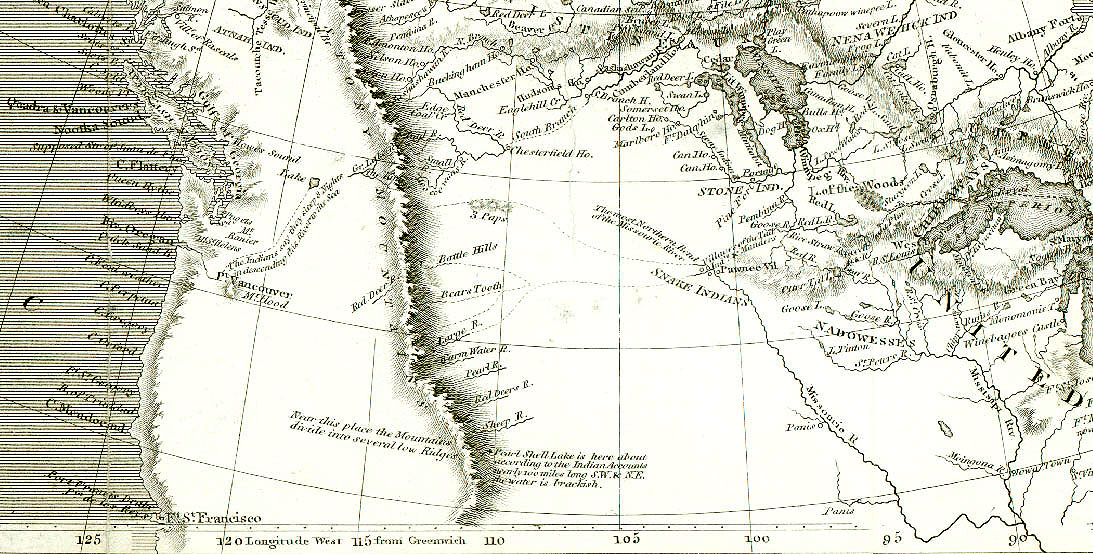
Examine the map: "British Possessions in North America" http://www.geospectra.net/lewis_cl/history/b_amer1.jpg
The map shows a portion of the North American West as it was known to Europeans in the early 1800s. Many areas are blank. In essence, Jefferson asked Lewis to fill in the "white spaces" on the map and to find an easily accessible water route to the West Coast by exploring the full length of the Missouri River. He instructed Lewis to describe the geography—the physical and human characteristics—of the places he saw.
How might this information have been useful to the United States of the early 1800s?
Read a version of Jefferson's instructions to Lewis, paraphrased here:

20 June 1803 To Meriwether Lewis esq. Capt. of the 1st regimt. of infantry of the U. S. of A. The object of your mission is to explore the Missouri River and other rivers to find a water route to the Pacific Ocean for the purpose of trade. You should make detailed notes throughout your journey, and make several copies of the notes. Choose the most trustworthy individuals to care for them. Make careful observations of latitude and longitude at all points on the river, especially at the mouths of rivers and other important places. We want to make new maps of the area. Plan to meet the Indian tribes and to begin trade with them. We want to know many things about the people you meet, including their tribe names, how many people are in each tribe, their languages and traditions, their occupations, any diseases they have and remedies they use, and the things they might need or offer in trade. Be sure to treat the natives in the friendliest manner that you are able. You should also notice and record information about new plants and animals that you observe and the minerals you find. Also record what the climate and landscape are like. Return the way you came and confirm the observations that you made on the way out.
PRESIDENT JEFFERSON'S INSTRUCTIONS TO CAPTAIN MERIWETHER LEWIS, 20 JUNE 1803 (EXCERPTS)
Analytical thinking
After reading the letter and exploring the primary source document, answer the following questions:
Where does Jefferson want the expedition to go?
Whom does Jefferson expect the expedition to meet?
What information does Jefferson want the expedition to report?
Why are all of these things important to Jefferson?
Explain, to Congress, why the expedition would be valuable to the future of the country. You should list four or five reasons. Supply relevant evidence to support your opinions. Consider the following questions to help you develop your list:
Is your reason based on a fact or an opinion?
How can you support you opinions—with facts, evidence, examples, or appeals?
After you have made your lists, explain your reasoning to the class.
Reflection:
How did the area that Lewis and Clark explored (the Louisiana Territory and the areas that other nations had claimed) become part of the U.S.? What would the U.S. be like if these areas had not become part of the country?
Student Written Assessment:
Summarize, by writing a letter to the Congress of 1803, the importance of the expedition's mission.
"It is 1803, and you have been assigned to help the President of the United States write a letter to Congress. President Jefferson's dream is to explore the land West of the Mississippi River to find an easily accessible water route to the Pacific Ocean. The President is convinced that this mission could succeed if he were given money and approval from Congress. You must help Jefferson write a letter to explain the importance of the expedition and what will be accomplished. The letter must convince Congress to support the mission."
Collaborative learning
Conduct a "mock Congress" and debate the reasons that the expedition should or should not be funded.
Credit: "Jefferson's Instructions to Lewis" adapted from "Education Volunteer Notebook," Lewis and Clark National Historic Trail Interpretive Center, USDA, Forest Service, 2000-2001. Full text of letter found in Donald Jackson, Letters of the Lewis and Clark Expedition with Related Documents, 1783–1854 (Urbana and Chicago, University of Illinois Press, 1978) pp. 61–66.
Related Links:
PBS: Lewis & Clark—The Journey of the Corps of Discovery
Lewis and Clark @ nationalgeographic.com
www.nationalgeographic.com/features/97/west
Wild Rivers. Rugged mountains. An uncharted continent to explore. This legendary American expedition faced them all, and you can be a member of their team.
www.nationalgeographic.com/features/97/west
Wild Rivers. Rugged mountains. An uncharted continent to explore. This legendary American expedition faced them all, and you can be a member of their team.
Discovering Lewis and Clark
www.lewis-clark.org
Interactive maps and journal entries let you follow the explorers’ paths at this rich but complex site.
www.lewis-clark.org
Interactive maps and journal entries let you follow the explorers’ paths at this rich but complex site.
Lewis and Clark in North Dakota
www.ndlewisandclark.com/frames.html
Trace the expedition’s progress, meet the key players, and learn about places you can visit.
www.ndlewisandclark.com/frames.html
Trace the expedition’s progress, meet the key players, and learn about places you can visit.
Lewis and Clark National Historic Trail Home Page
www.nps.gov/lecl
The National Park Service provides a wealth of information for those yearning to follow Lewis and Clark.
www.nps.gov/lecl
The National Park Service provides a wealth of information for those yearning to follow Lewis and Clark.
Lewis and Clark
www.pbs.org/lewisandclark
From classroom activities to Indian perspectives to an interactive adventure, this companion site to the Ken Burns documentary offers a comprehensive look at Lewis and Clark’s journey.
www.pbs.org/lewisandclark
From classroom activities to Indian perspectives to an interactive adventure, this companion site to the Ken Burns documentary offers a comprehensive look at Lewis and Clark’s journey.
The Rivers of Lewis and Clark
www.americanrivers.org/lewisclark/default.htm
Journey down the Missouri River and explore important spots along Lewis and Clark’s route.
www.americanrivers.org/lewisclark/default.htm
Journey down the Missouri River and explore important spots along Lewis and Clark’s route.
CUNY: President Thomas Jefferson's Instructions to Captain Meriwether Lewis (June 20, 1803)
Emporia State University: Historical Background of the Lewis and Clark Expedition
Library of Congress: The Lewis and Clark Expedition
Smithsonian Institute: Lewis & Clark—Mapping the West